Security and verification
Can a stablecoin transfer be blocked if you hold the keys?

At a glance
Yes, for tokens that give an issuer transfer controls. Holding wallet keys lets you sign a request; it does not override a token contract’s address blocklist or pause. Circle’s documented USDC design illustrates the distinction. Other tokens and networks can differ, and direct cash-redemption eligibility is a separate question.
On this page
Keeping your wallet keys gives you signing authority. It does not necessarily give you authority over the rules of every token in that wallet. A token issuer can retain controls that a wallet backup does not remove.
USDC provides a concrete example. Circle’s blocklisting explanation says it can prevent a specified address from sending or receiving USDC or EURC in limited circumstances. That restriction can apply even when the holder still has the wallet keys.
Separate the signer from the token
For a conventional Ethereum externally owned account, a private key lets its holder sign transactions. Ethereum.org’s account documentation distinguishes these accounts from contract accounts, whose behavior is controlled by code.
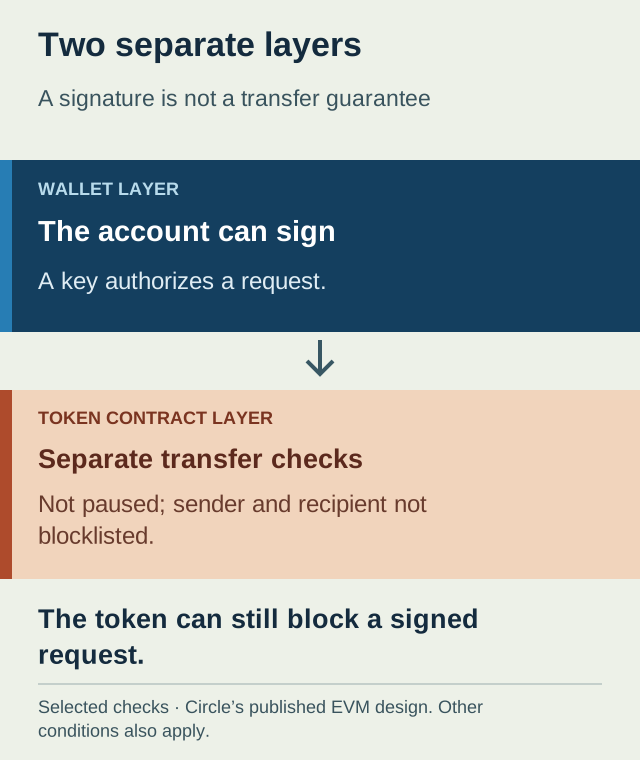
A signed request involving a token still encounters that token’s contract rules. The key is not an administrative credential for the token contract. Restoring the same account in another wallet does not, by itself, change those rules or an address restriction.
The example below uses Circle’s published EVM contract design. It is not a claim that every stablecoin, blockchain, wallet design or bridged token has identical controls.
Map the different kinds of control
Circle’s design document identifies separate roles for address blocklisting and contract pausing. The following map combines those controls with account signing and the separate issuer-redemption process.
| Control | What it affects | What it does not establish |
|---|---|---|
| Wallet signing authority | Who can authorize a request from the account | That the token contract will accept the transfer |
| Address blocklist | Transfers involving particular addresses under the token’s rules | That every asset in the wallet is frozen |
| Token contract pause | Transfers across that particular token contract while paused | That the whole blockchain has stopped |
| Direct issuer redemption eligibility | Whether a holder can use the issuer’s cash-redemption service under its terms | That ordinary token transfers are blocked |
The blocklister role changes the address list; the pauser role changes the contract’s pause state. These are separate from possession of an ordinary holder’s wallet key. A blocklist targets addresses, while a pause has a broader effect within the affected contract.
What the published code checks
In the pinned transfer implementation, the transfer function checks that the contract is not paused and that neither sender nor recipient is blocklisted before moving tokens. The balance-reading function does not have those transfer gates. A balance being readable is therefore different from that balance being transferable.
This is a source-code cross-check of the documented mechanism. We did not connect a wallet, query a particular holder’s status or establish which implementation is currently deployed on every supported network.
Avoid describing blocklisting as disabling every operation. Circle’s design says version 2.2 and later can allow approval and allowance operations for blocklisted addresses when the contract is not paused, while still blocking transfers. A successful approval would not override the transfer restriction. Our wallet-approval explainer covers the separate authority granted to a spender.
Circle also distinguishes blocklisting from undoing a transfer: its help page says it cannot reverse or recall a completed USDC or EURC transfer. Preventing a later movement is not a promise that an earlier payment can be recovered.
Transfer access is different from cash redemption
A holder may be able to move tokens without being eligible to redeem directly with the issuer. Conversely, holding the keys does not prove access to an issuer account or cash-redemption service.
Circle’s USDC Terms, marked last updated October 15, 2026, apply to holders outside the European Economic Area. They require an eligible Circle Mint account in good standing for direct redemption with Circle, subject to the terms. The page directs EEA holders to separate documentation. This example does not determine anyone’s eligibility or legal rights.
That service distinction is separate from the transfer controls above. Our dollar peg and cash proceeds article explains another question: how a sale price and costs can differ from a token’s reference value.
Check the specific asset before diagnosing a failure
- Record the network and exact token contract. For USDC, start from Circle’s official contract list; a ticker alone does not identify the implementation.
- Read the current documentation for that asset and network. Distinguish an address restriction, a token pause and a service-account restriction.
- Preserve the transaction hash, time and actual error if a request failed. Failure alone does not prove blocklisting or wrongdoing.
- Use the issuer’s or service’s verified support route for an unresolved restriction. Keep recovery phrases and private keys private.
A wallet recovery procedure addresses access to signing material; it cannot by itself promise removal of a token restriction. See the wallet recovery responsibility map when access to the account itself is the problem.
Editorial note: CoinFom prepared this article with AI-assisted research, writing, translation and review. Sources checked October 26, 2026. No wallet was connected and no transaction or recovery request was performed. Educational information, not personalized investment or legal advice. CoinFom may earn referral commissions elsewhere; this article has no signup link. See About CoinFom, our editorial policy, and corrections.