Risk and methods
Why a 20% loss needs a 25% gain to recover

At a glance
A loss is measured against the earlier value; recovery is measured against the smaller value left afterward. Falling from 100 to 80 is a 20% loss, but returning from 80 to 100 requires 25%. Costs and cash movements must be treated separately, and the calculation does not predict a recovery.
On this page
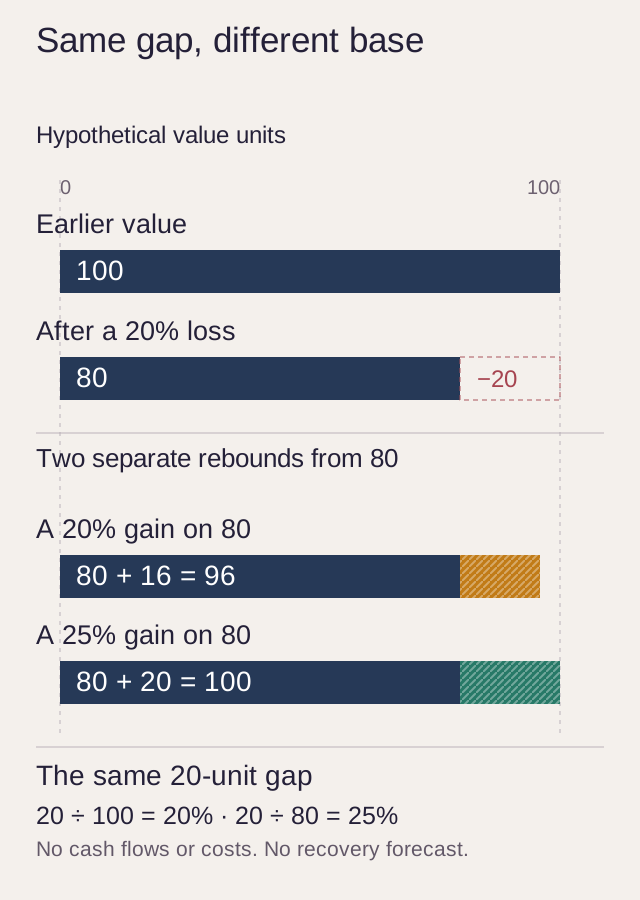
A value falls from 100 to 80. It then rises 20%. The result is 96, not 100. Nothing is missing: the decline was measured against 100, while the rebound started from 80.
That change of base explains why the percentage gain needed to recover a loss is larger than the percentage loss. It does not tell us whether a recovery will happen.
Give each percentage its own starting value
These are invented value units, not actual prices or trading results. Use the same asset or account-value measure throughout, with no deposits, withdrawals, distributions or costs for now. The earlier value is positive.
Eurostat's percentage-change definition uses the earlier value as the base. An equivalent formula is:
Percentage change = (later value − earlier value) ÷ earlier value × 100
| Hypothetical move | Change in units | Starting value | Percentage change |
|---|---|---|---|
| 100 → 80 | −20 | 100 | −20% |
| 80 → 96 | +16 | 80 | +20% |
| 80 → 100 | +20 | 80 | +25% |
The last two rows are alternative rebounds from 80, not consecutive moves. In this example, the fall from the selected peak of 100 to 80 is a 20% drawdown. Returning to that peak requires the same 20 units that were lost. But 20 is one quarter of the remaining 80: 20 ÷ 80 = 25%.
A larger loss changes the calculation further
CME's loss-and-recovery table also pairs a 20% loss with a 25% recovery gain and a 50% loss with a 100% recovery gain. Only that arithmetic is used here.
For the second case, 100 → 50 loses 50% of 100. Returning 50 → 100 adds 50 to a base of 50, so the required increase is 100%. A 50% rebound would reach only 75.
For a loss fraction d, with 0 ≤ d < 1, the remaining fraction is 1 − d. The recovery fraction is therefore d ÷ (1 − d). With d = 0.20, that is 0.20 ÷ 0.80 = 0.25, or 25%. This calculation requires d to be below 1: after a complete loss, multiplying a zero balance by a finite growth factor still gives zero.
Also distinguish percentages from percentage points. The numbers 20% and 25% differ by five percentage points, following Eurostat's definition. That comparison does not represent five extra units or a 5% return on the remaining value.
A gross recovery can still miss a net target
The SEC's fees bulletin explains that costs reduce investment value and returns. Add one explicit, hypothetical cost to our example: exactly one unit deducted at the end, with no other costs or cash movements.
A gross 25% increase takes 80 to 100; the deduction leaves 99. To finish at a net 100, the value before that deduction must reach 101:
(101 − 80) ÷ 80 × 100 = 26.25%
This is an invented fixed cost, not an exchange fee quotation. Costs already reflected in the starting 80 must not be subtracted again. For account records, see reconciling realized profit and fees.
Returning to a balance is not always earning a return
Adding a separate deposit of 20 to 80 also produces 100. That deposit is new money, not a 25% investment gain. Record cash movements separately; our trading-journal guide explains keeping records traceable.
These equations do not model leverage or liquidation, identify a strategy, or establish how likely or how quickly an asset will revisit an earlier value.
Editorial note: CoinFom prepared this article with AI-assisted research and writing. No trade was performed; all examples are hypothetical. Sources checked October 23, 2026. Educational information, not personalized investment advice. CoinFom may earn referral commissions elsewhere; this article has no signup link. See About CoinFom, our editorial policy, and corrections.