Trading costs
A profitable price move, a smaller account balance

At a glance
Price profit and net account change answer different questions. Reconcile entry and exit fills, fees, funding and transfers, then check which costs the platform already includes in its realized-P&L field.
On this page
A green position number can coexist with a disappointing final balance. Before treating either as wrong, check the measurement: open-position price profit, closed-trade net result and total account change are not interchangeable.
Begin with fills, not the screenshot
For a simple linear long, price profit is quantity multiplied by exit price minus entry price. Use actual weighted fill prices. Bybit's P&L FAQ distinguishes unrealized and realized results and their cost treatment. Labels and included charges must be read in the context of the product; do not reuse this arithmetic for inverse contracts without their formula.
Imagine five fictional units bought at 100 USDT and sold at 101 USDT. Gross price profit is 5 × (101 − 100) = 5 USDT. Assume the following recorded costs, rather than a particular exchange fee schedule:
| Ledger item | Effect |
|---|---|
| Gross price profit | +5.00 USDT |
| Entry fee | −0.50 USDT |
| Exit fee | −0.505 USDT |
| Funding paid | −1.00 USDT |
| Net result | +2.995 USDT |
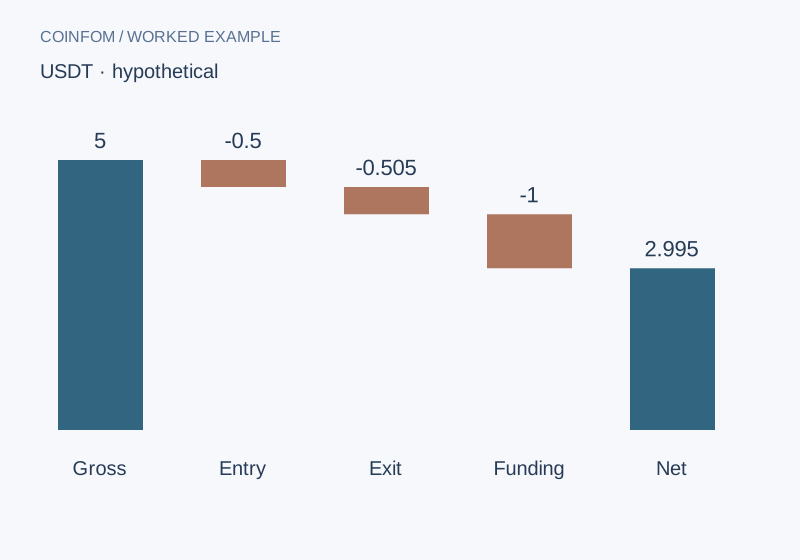
Keep the extra decimal during reconciliation; the interface may round its display. A hypothetical 100 USDT starting balance becomes 102.995 if this is the only activity and all amounts use the same settlement unit.
Avoid the second subtraction
If a platform already reports 2.995 as a net realized result, subtracting the same 2.005 of fees and funding again produces a false 0.99. Trace what a field includes before combining it with another field. The futures fee explanation helps identify execution charges separately from the price movement.
An account can also receive deposits, withdrawals, transfers or rebates unrelated to the closed trade. In this example, a separate 10 USDT withdrawal would leave 92.995, despite positive net trading results. That does not turn the withdrawal into a trading loss.
A repeatable reconciliation
Choose the account, settlement currency and time window. Record starting balance and all cash movements. Match the trade's order IDs to fills and fee entries, then add funding receipts or subtract funding payments with consistent signs. Compare the reconstructed balance to the ending record and investigate any difference before assigning a cause.
Keep cashback as a separate credited item only when it actually appears. An expected rebate is not an available balance, and a statement estimate is not payout evidence. Our cashback explanation describes CoinFom's offer conditions; it does not replace your exchange ledger.
CoinFom editorial note: research, writing, translation and review used AI assistance. No live transaction was performed for this article. Numerical examples are hypothetical and do not demonstrate returns. Sources checked September 26–27, 2026. Educational content, not personalized advice. See About CoinFom, our editorial and affiliate policy, or send a correction. CoinFom may earn referral commissions on other pages; this article contains no signup link.