Trading costs
Funding costs over one, three and seven days

At a glance
Funding expense depends on the position value and applicable rate at each settlement you hold through. A displayed rate is not necessarily a daily rate. Sum actual settlements separately from entry and exit trading fees.
On this page
A small percentage beside a countdown can become a meaningful cost over several days. Start by asking what period it covers. Multiplying the displayed funding rate by a number of days can undercount or overcount the settlements your position actually crosses.
Define the scenario before calculating
Bybit's funding documentation describes payments between long and short holders at settlement, with intervals that can vary by contract. For USDT perpetuals, the calculation uses position value times the applicable funding rate. This is separate from the fees charged on executions.
Our hypothetical long has a constant 2,000 USDT value, pays 0.01% every eight hours, and crosses exactly three settlements per day. These are fixed assumptions for arithmetic, not current terms or a forecast. One settlement costs 2,000 × 0.0001 = 0.20 USDT.
| Holding scenario | Settlements crossed | Funding paid |
|---|---|---|
| 1 day | 3 | 0.60 USDT |
| 3 days | 9 | 1.80 USDT |
| 7 days | 21 | 4.20 USDT |
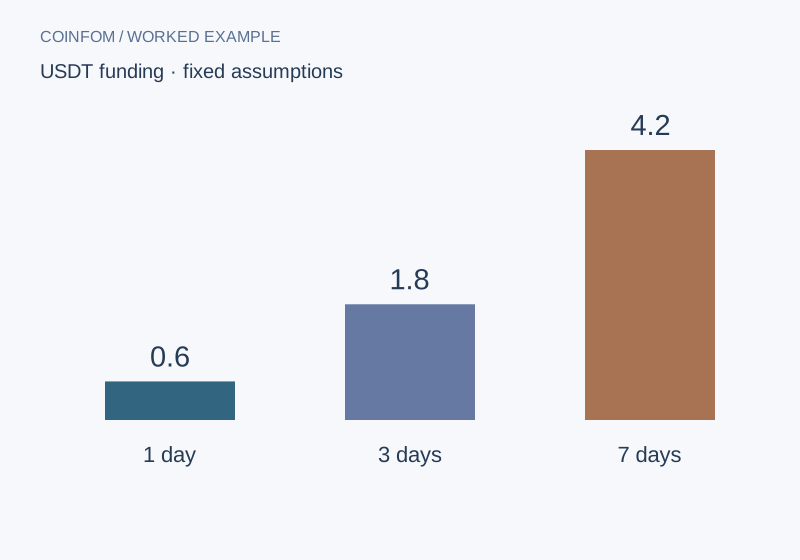
Assume entry and exit each cost 1 USDT. Combined execution and funding costs become 2.60, 3.80 and 6.20 USDT respectively. Price gains or losses, slippage and borrowing are excluded. We have not applied cashback to funding.
Replace assumptions with observations
For a real reconciliation, make one row per settlement: timestamp and timezone, position value, rate, payment direction and actual debit or credit. Rates can change sign, position value can change with price, and the interval can change. A seven-day total is a sum of those rows, not proof that the first rate lasted all week.
Suppose three actual settlements on a constant 2,000 value are +0.01%, −0.005% and +0.02%. For this long, payments are 0.20, a receipt of 0.10, and a payment of 0.40: net cost 0.50 USDT. Record receipts explicitly rather than losing their sign.
What this estimate cannot decide
A favorable funding receipt can be outweighed by an adverse price move. Neither receiving funding nor obtaining a trading-fee rebate makes a leveraged position safe. Check contract-specific timing before using a calendar estimate, and do not assume a last-second close avoids settlement. Use CoinFom's tools for supported fee scenarios; compare the tool's stated scope with the additional costs in your own ledger.
CoinFom editorial note: research, writing, translation and review used AI assistance. No live transaction was performed for this article. Numerical examples are hypothetical and do not demonstrate returns. Sources checked September 26–27, 2026. Educational content, not personalized advice. See About CoinFom, our editorial and affiliate policy, or send a correction. CoinFom may earn referral commissions on other pages; this article contains no signup link.