Wallets and transfers
Bitcoin change: reconcile the payment, remainder and fee

At a glance
In an ordinary Bitcoin transaction, the selected inputs are spent in full. A change output can return the remainder to the sender’s wallet. The miner fee is the total input value minus total output value, not another output. Confirm which output your wallet owns; do not infer ownership from its position or size.
On this page
A Bitcoin explorer may show more value leaving an address than you intended to pay. That alone does not tell you how much another person received. Read the inputs, all outputs and fee together.
This explanation covers an ordinary Bitcoin on-chain payment from a self-custody wallet. It does not describe Lightning payments or an exchange’s internal ledger.
Why the remainder needs an output
A UTXO is an unspent transaction output: a piece of value available to spend. Spending it consumes that selected output in full. The wallet can create a new output returning the remainder to itself. The Bitcoin developer guide’s fee-and-change section explains this accounting; its historical minimum-fee discussion is not a current fee recommendation.
Trezor’s wallet documentation describes Trezor Suite returning remaining value to a newly generated wallet address. That product behavior does not prove that every unfamiliar address in an explorer belongs to you.
Reconcile a hypothetical payment
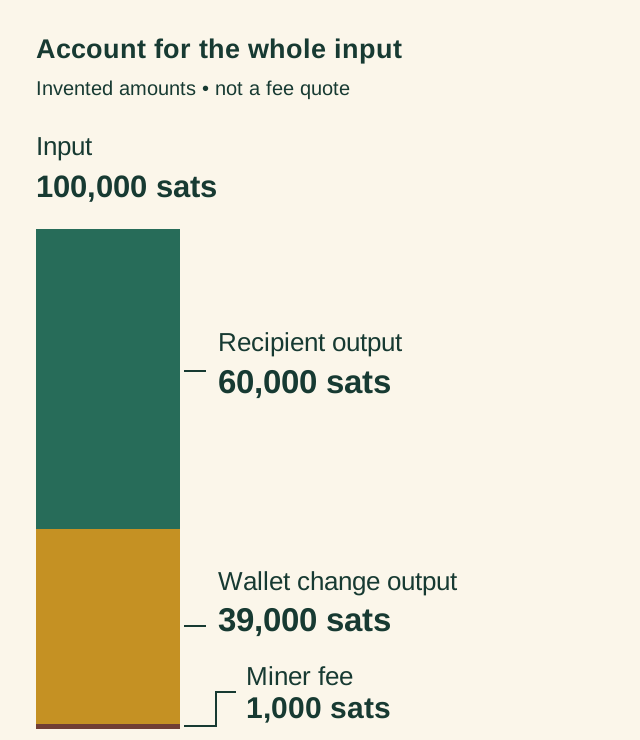
Assume one input worth 100,000 sats, a recipient payment of 60,000 sats, and an invented miner fee of 1,000 sats. No transfer was performed; 1,000 sats is not a current fee estimate or minimum.
| Item | Amount (sats) | Role |
|---|---|---|
| Selected input | 100,000 | Previously unspent value consumed |
| Recipient output | 60,000 | Payment |
| Wallet change output | 39,000 | Remainder controlled by the sender in this example |
| Miner fee | 1,000 | Input minus all outputs; not an output |
100,000 = 60,000 + 39,000 + 1,000. The outputs total 99,000 sats. Subtracting that total from the input gives the 1,000-sat fee. The sender’s hypothetical wallet value falls by 61,000 sats, not by the full input value, because it retains 39,000 sats as change. This is not a complete wallet balance calculation: other UTXOs are outside the example.
What to check before calling it change
- Match the intended recipient’s full address and payment amount against the output in your wallet’s transaction details.
- Use the wallet’s own records to identify its change output. An explorer’s output order, amount or label alone is not proof of control.
- Add every input and output. For several inputs, use their combined value; do not subtract only the recipient payment and call the remainder a fee.
- Keep fee accounting separate from confirmation and deposit credit. Correct arithmetic does not prove receipt, confirmation or exchange credit.
If your wallet cannot account for an output, pause and use its official support documentation. Never give a recovery phrase to someone offering to identify change. Read our wallet recovery responsibility map and full-address checking article. Not every transaction has change or exactly two outputs.
Editorial note: CoinFom created the worksheet with AI-assisted research, writing, translation and review. Sources checked October 9, 2026. No transaction or wallet test was performed. Educational information, not investment advice. CoinFom may receive referral commissions elsewhere; this article has no signup link. See About, editorial policy and corrections.