Order execution
Why a spot order can fail despite enough balance

At a glance
A funded spot limit order can still fail a price increment, quantity increment or minimum-value rule. Check each condition for the exact pair and order type. Rounding the quantity down may miss the minimum; rounding up may exceed your budget. Passing these checks still does not guarantee acceptance or a fill.
On this page
An order can cost less than the balance available for that order and still contain numbers the exchange does not accept. A quantity rule, a price rule and an order-value rule answer different questions. This article examines a fully funded spot limit buy; it does not quote a live trading minimum or cover borrowing and futures.
Three checks with different units
Binance Spot's filter specification separates price rules, quantity rules and order-value rules. For a fixed-price limit order, the value is price multiplied by quantity.
| Check | Unit | What to inspect |
|---|---|---|
| Price tick | Quote currency per token | Whether the entered price is a permitted increment and within applicable bounds |
| Quantity step | Tokens | Whether the quantity is a permitted increment and within applicable bounds |
| Minimum order value | Quote currency | Whether price × quantity reaches the required value |
The specific filter names include PRICE_FILTER, LOT_SIZE and MIN_NOTIONAL or NOTIONAL. Some rules also impose maxima; other filters can apply. Treat the documentation's sample numbers as examples, not current settings for your pair.
A budget between two quantity steps
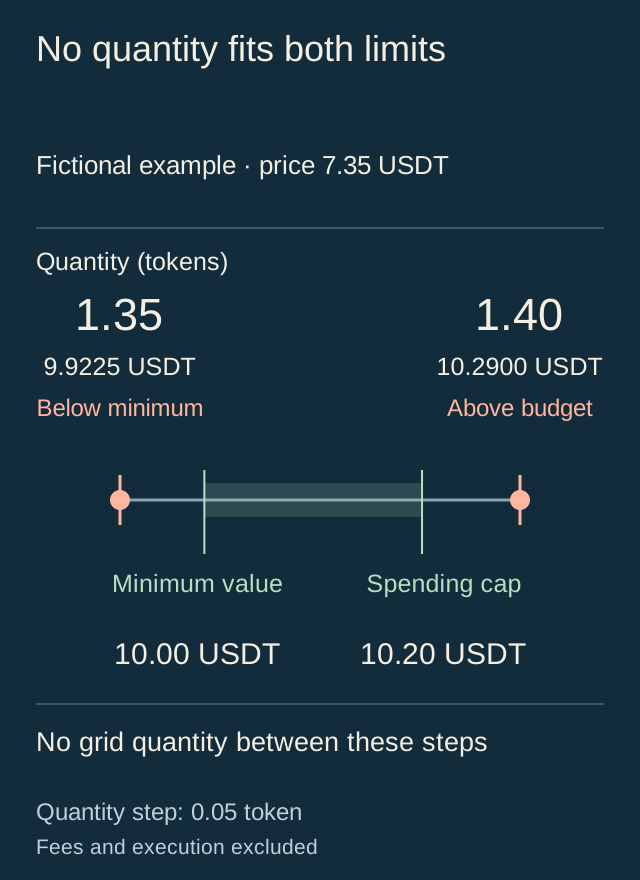
Here is an invented worksheet, not a Binance or Bybit pair. Assume a limit price of 7.35 USDT per token, a price tick of 0.05 USDT, a minimum quantity of 0.10 token, and quantity increments of 0.05 token. The minimum order value is 10.00 USDT. Your available spending cap is 10.20 USDT. Assume other bounds do not bind, and exclude fees and execution.
The price fits its grid: 7.35 ÷ 0.05 = 147. The proposed quantities produce different problems:
| Quantity in tokens | Quantity ÷ 0.05 | Order value in USDT | Result in this example |
|---|---|---|---|
| 1.36 | 27.2 | 7.35 × 1.36 = 9.9960 | Not a permitted quantity increment; also below 10.00 |
| 1.35 | 27 | 7.35 × 1.35 = 9.9225 | Permitted increment, but below 10.00 |
| 1.40 | 28 | 7.35 × 1.40 = 10.2900 | Clears the minimum, but exceeds the 10.20 cap |
There is no quantity on this grid that satisfies both the minimum value and your spending cap at 7.35. The smallest qualifying quantity is 1.40; the largest affordable grid quantity is 1.35. Stopping is a valid result. An exchange minimum is not a reason to increase your budget.
Display rounding is not rule compliance
The first row's 9.9960 can display as 10.00 when rounded to two decimal places. Its unrounded value remains below 10.00. Similarly, a price of 7.37 has two decimal places but is not a multiple of the fictional 0.05 tick. Count the permitted increments, not only decimal digits.
Changing a quantity or limit price changes the instruction you are giving. Recalculate its value and your own cap after any deliberate edit. In a real order, account for applicable fees separately; this worksheet did not reserve a fee allowance or simulate a fill.
Use the current rules for the exact market
Field names differ between exchanges and products. In Bybit's Spot instrument schema, minOrderAmt describes the minimum amount; the old minOrderQty field is deprecated. Its spot schema lists basePrecision and quotePrecision, while priceFilter contains tickSize. Do not copy a derivatives quantity-step field into a spot calculation.
Bybit's trading-rules help also describes price limits and order limits and links to its current pair-specific rules. This article does not verify a live minimum for any pair or establish regional account availability.
For a rejected order, keep the exact error, pair, order type, price and quantity together. Compare them with the current official rules before editing the order. If those numbers fit, other restrictions may still matter. A numerical check is not an acceptance guarantee, and acceptance is not execution. See post-only cancellations for a different cause, or partial fills and time in force for what happens to unfilled quantity.
Editorial note: CoinFom created this worksheet using AI-assisted research, writing, translation and review. Sources checked October 20, 2026. No account was connected and no order was submitted. Educational information, not a recommendation to trade. CoinFom may earn referral commissions elsewhere; this article contains no signup link. See About, editorial policy and corrections.