Wallet troubleshooting
Why one pending Ethereum transaction can hold up the next

At a glance
Ordinary transactions from the same Ethereum account use an ordered nonce sequence. A missing earlier nonce can delay later ones. Wallet speed-up or cancellation attempts replace a pending transaction; they cannot undo one already confirmed.
On this page
You submit a second transaction with a generous fee, but it still waits. The bottleneck may be its place in the account sequence rather than only its fee. Check the earlier transaction before adding a third.
A counter, not a payment amount
The Ethereum transaction specification describes the nonce as an account transaction counter. For ordinary externally owned account transactions, execution follows that account's sequence. This article does not cover specialized smart-account nonce schemes.
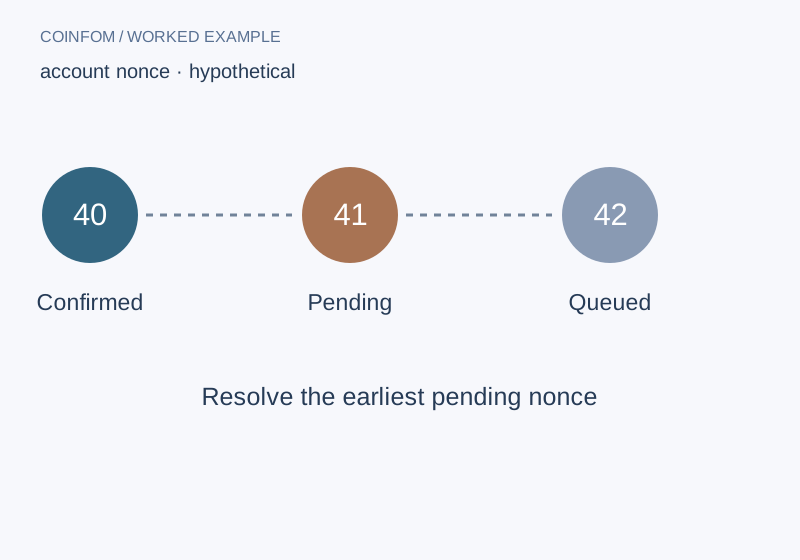
Suppose nonce 40 is confirmed, 41 is pending and 42 is queued. Transaction 42 cannot simply skip the missing 41 in this sequence. Raising the fee on 42 does not by itself complete 41. The numbers identify ordering; they are not confirmation counts, token quantities or priorities across all users.
| Nonce | Hypothetical status | What to investigate |
|---|---|---|
| 40 | Confirmed | Historical receipt |
| 41 | Pending | Earliest unresolved transaction |
| 42 | Queued | Dependency on the earlier nonce |
Replacement is not reversal
MetaMask's official guide explains its speed-up and cancellation options. These attempt replacement while a transaction is pending. A confirmed transfer cannot be canceled retroactively by changing a wallet screen.
For example, if a replacement for nonce 41 is confirmed, the original instruction for that same account nonce cannot also execute as an additional ordinary transaction. But until the result is known, do not assume the attempted cancellation won the race. Inspect the confirmed transaction's recipient, value and status rather than the newest local label alone.
Diagnose without sharing secrets
First confirm the network and public sender address. Find the earliest unresolved nonce and its transaction hash. Check whether the wallet's pending label agrees with the network record. Then use the wallet's official instructions appropriate to that status; do not improvise by entering private keys into a recovery website.
A missing explorer result is not sufficient proof that a transaction can never appear. Likewise, clearing a local activity display does not reverse network state. Preserve hashes and screenshots before making changes so later events can be matched.
Keep the next action narrow
Avoid repeatedly submitting the same payment with new nonces: if they later execute, they may become separate payments. Resolve the sequence and verify balances before retrying. The distinction between a network record and a receiving platform's credit also matters; our Bitcoin deposit article illustrates that separate concept, without applying Bitcoin confirmation rules to Ethereum.
CoinFom editorial note: research, writing, translation and review used AI assistance. No live transaction was performed for this article. Numerical examples are hypothetical and do not demonstrate returns. Sources checked September 26–27, 2026. Educational content, not personalized advice. See About CoinFom, our editorial and affiliate policy, or send a correction. CoinFom may earn referral commissions on other pages; this article contains no signup link.