Network costs
Ethereum gas: the maximum budget is not the final bill

At a glance
For an ordinary Ethereum execution transaction, the execution fee is gas used times the effective gas price. The gas limit and maximum fee per gas describe a ceiling, not necessarily the final charge. More complex transactions and other networks require their own fee model.
On this page
A wallet preview can show a maximum fee above the eventual charge. To reconcile it, keep two dimensions apart: how much computation is used and how much each unit costs. A higher budget is not evidence that the entire amount was spent.
Units before currency
Ethereum's gas documentation explains gas as a measure of execution work and the base-fee and priority-fee components. Its transaction reference distinguishes the gas limit from per-gas fee caps. Here we cover an ordinary execution fee, excluding blob fees and layer-2-specific components.
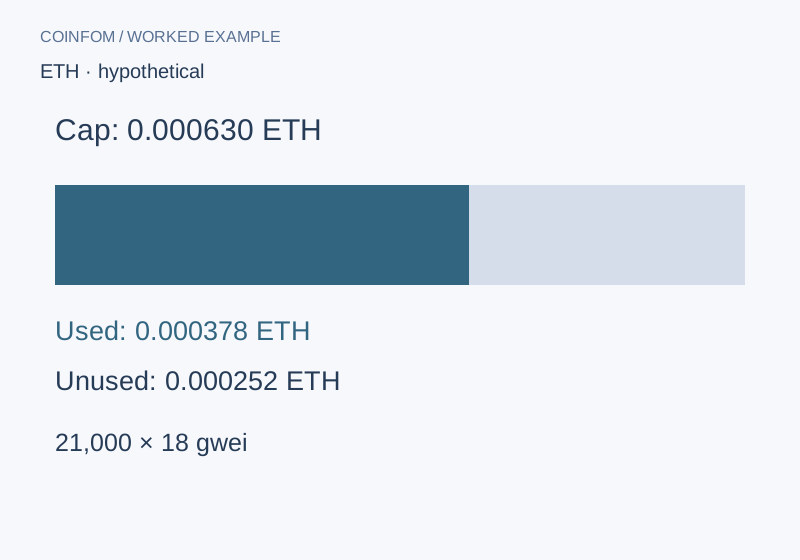
One gwei is 0.000000001 ETH. In a hypothetical plain transfer that uses 21,000 gas at an effective 18 gwei per gas, the charge is:
21,000 × 18 × 0.000000001 = 0.000378 ETH.
If its gas limit is 21,000 and its maximum fee is 30 gwei, the corresponding ceiling is 0.000630 ETH. The difference, 0.000252 ETH, is unused budget in this scenario, not cashback and not investment income.
| Quantity | Assumption | Meaning |
|---|---|---|
| Gas used | 21,000 | Work consumed |
| Effective price | 18 gwei | Price per consumed unit |
| Actual execution fee | 0.000378 ETH | Product of the two |
| Maximum budget | 0.000630 ETH | Assumed cap, not final bill |
Do not reuse the transfer estimate everywhere
A token transfer, approval or swap can execute contract logic. The plain-transfer assumption is not a safe universal gas limit. Forcing an unsuitable limit can cause failure; work already consumed can still cost money. A failed application action does not necessarily mean a free blockchain transaction.
An ETH-to-dollar conversion is another calculation at a specified exchange rate and time. We do not provide one here because no market quote has been supplied. A wallet's later fiat display can change without the historical ETH fee changing.
Reconcile from the receipt
Record the transaction hash, network, status, gas used and effective gas price from the confirmed record. Multiply those last two using consistent units. Compare the result with the execution fee, not with the transfer amount or a platform's separate withdrawal charge.
If the account paid another service fee, keep it as another line instead of assigning every deduction to gas. Before moving funds, our transfer checklist covers the separate destination and network checks.
CoinFom editorial note: research, writing, translation and review used AI assistance. No live transaction was performed for this article. Numerical examples are hypothetical and do not demonstrate returns. Sources checked September 26–27, 2026. Educational content, not personalized advice. See About CoinFom, our editorial and affiliate policy, or send a correction. CoinFom may earn referral commissions on other pages; this article contains no signup link.