Market data
Volume rises, open interest stays flat: why both can be right

At a glance
Volume measures trading during a period; open interest measures outstanding contracts at an observation. Trading can transfer an existing position without increasing open interest. A larger open-interest figure alone does not establish a bullish or bearish forecast.
On this page
A dashboard shows heavy trading but little change in open interest. That is not necessarily contradictory. One number counts activity over a period; the other counts contracts still outstanding at a point in time.
Flow and outstanding inventory
CME's educational explanation distinguishes traded volume from outstanding futures contracts. Its data reports also have defined products and reporting periods. Crypto dashboards may aggregate different venues and units, so inspect their methodology rather than assuming identical coverage.
A contract has a long and a short side. Counting one outstanding contract once is different from adding both sides as two. An increase in contracts does not mean there are unmatched longs with no shorts.
Follow three hypothetical events
Start with zero open interest in a fictional contract. Each row below trades one contract; assume no other activity.
| Event | Cumulative volume | Open interest afterward |
|---|---|---|
| New buyer and new seller open | 1 | 1 |
| Existing long exits to a new long; short remains | 2 | 1 |
| Existing long and existing short both close | 3 | 0 |
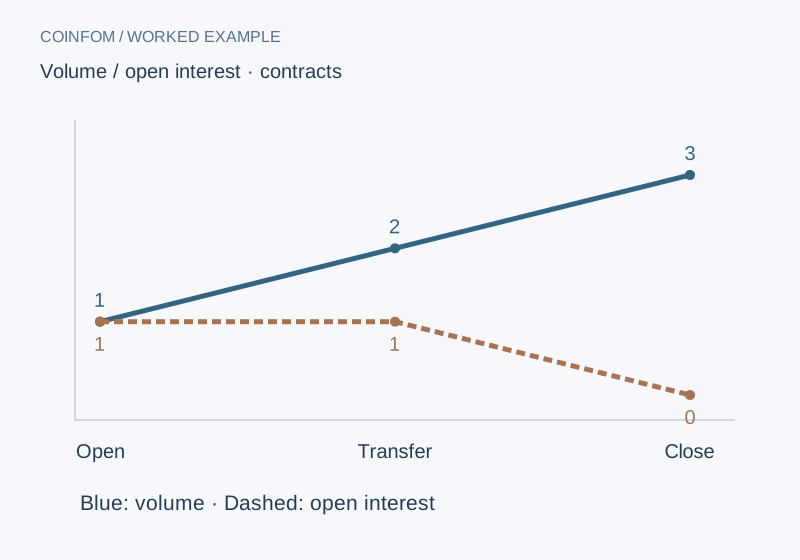
The middle row explains the apparent contradiction: a contract traded, but the outstanding count did not grow. The final row adds volume while reducing open interest. The ledger describes position accounting, not participants' motives or a price forecast.
Check whether a value changed or a quantity changed
Suppose a provider converts ten units of exposure to dollars using price. At 100 USD, the displayed notional is 1,000 USD; at 110, it is 1,100 USD. The dollar figure grew 10% with unchanged quantity. This simplified conversion example shows why unit definitions matter; actual contract multipliers and inverse products require their own calculation.
Record whether a chart reports contracts, underlying coin units or converted currency. Also record contract expiry or perpetual scope, venue coverage, timestamp and whether the value is preliminary or revised.
Do not turn a count into intent
Higher open interest can accompany different strategies, including offsetting exposure elsewhere. It cannot reveal a participant's complete portfolio. Volume does not establish quality of liquidity available for your order, and neither measure gives a guaranteed direction.
Use the data to form a precise question rather than a buy/sell instruction. For prices that also differ by definition, see last, index and mark.
CoinFom editorial note: research, writing, translation and review used AI assistance. No live transaction was performed for this article. Numerical examples are hypothetical and do not demonstrate returns. Sources checked September 26–27, 2026. Educational content, not personalized advice. See About CoinFom, our editorial and affiliate policy, or send a correction. CoinFom may earn referral commissions on other pages; this article contains no signup link.